
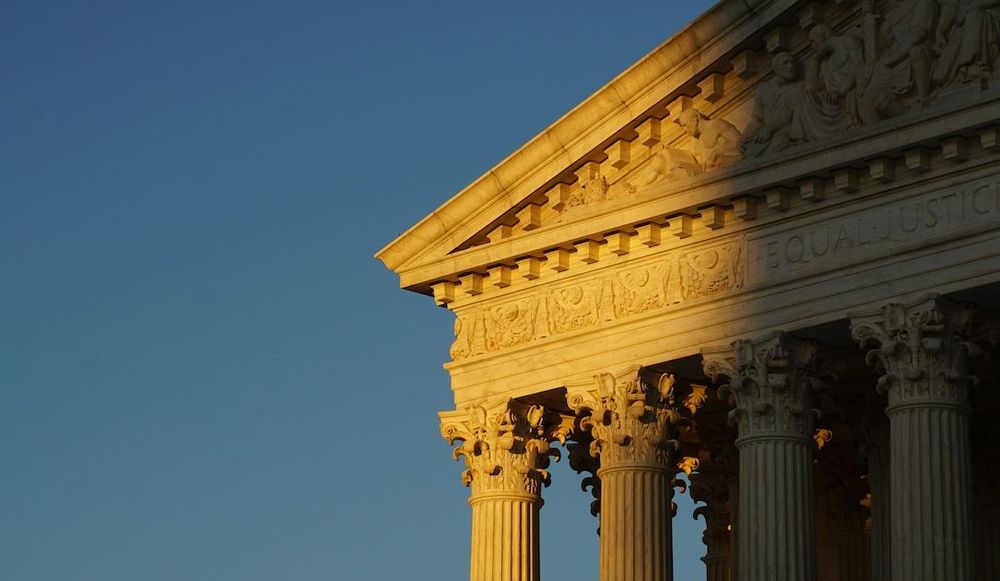
Supreme Court signals location data searches should require a warrant
The Supreme Court signaled during oral arguments Monday that it is likely to rule that police sweeps of all cell phones located in an area surrounding a crime scene qualify as a Fourth Amendment protected search and therefore require a warrant.
While police now typically get warrants to execute so-called geofence searches, the government is arguing in the Chatrie v. United States case that such probes do not trigger Fourth Amendment protections.
Privacy advocates had worried that the high court would rule that geofencing does not qualify as a constitutionally protected search, opening the door to much broader use of warrantless reverse searches of all types, including those where police ask Google to turn over information about everyone who searched for a specific keyword.
By the end of Monday’s hearing it seemed clear that a majority of justices will rule that location data searches require a warrant. Some justices seemed to indicate that they see a need to rule in a way that lays out requirements for location data searches to be as narrow as possible.
The justices did not split across typical ideological lines. Justice Neil Gorsuch, a conservative, joined liberal justice Sonia Sotomayor in asking the government’s lawyer hard questions about whether he was arguing that police should also be able to seize other data like photos, emails and Google documents without a warrant.
The case is the first Supreme Court argument to deal with data privacy since 2018, when the court ruled that police need a warrant to obtain 7 days or more of an individual's historic cell-site location information — gathered from cell towers — in the landmark Carpenter v. United States case.
Okello Chatrie, the plaintiff in the current case, is serving a nearly 12-year-sentence for bank robbery. He was only convicted because police were able to find him after they asked Google to turn over the names of everyone whose cell phone location data showed them in the area surrounding the credit union that was robbed in the time frame during which the robbery occurred.
Chatrie’s lawyer, Adam Unikowsky, argued that geofence searches should be considered general warrants, which are banned under the Fourth Amendment. General warrants gave British officers in the colonial era blanket authority to search without probable cause.
Some justices on Monday seemed skeptical of that argument, but still raised concerns about how broad geofence searches can be.
Google submitted an amicus brief on behalf of Chatrie, arguing that geofence searches are often broadly worded and invasive.
The tech giant told the court that it has received, for example, a geofence warrant that covered several search areas for a combined 2.5 square miles of San Francisco for more than 48 hours worth of time.
“This geofence warrant would have exposed the location history of thousands of users,” the Google brief said.
In another case, Google said, police asked for data that would have covered more than 3,000 users located in a 489-acre area that included the Islamic Center of New Mexico, 50 homes, 30 apartment buildings, a park, major roadways and a chunk of the University of New Mexico campus.
While the court does not seem poised to ban geofence warrants, the justices did seem to focus attention on how “particularized a warrant must be,” said Andrew Guthrie Ferguson, a law professor at George Washington University and the author of Your Data Will Be Used Against You.
“As we have seen in the Supreme Court’s other digital surveillance cases, the Justices seem to be more comfortable with a compromise approach, requiring judicial warrants to put some limits on law enforcement searches, but also not banning them completely,” Ferguson said via email.
Ferguson said he sees the court’s apparent inclination to require warrants for geofence searches as a big win since there is currently no mandate for them and police have typically sought warrants as a “concession that they think a court might require one.”
“That is why this case is a big deal,” Ferguson said. “If the government's argument wins, police can get a geofence warrant without any probable cause, for any reason, against anyone, anywhere in America.”



Suzanne Smalley
is a reporter covering digital privacy, surveillance technologies and cybersecurity policy for The Record. She was previously a cybersecurity reporter at CyberScoop. Earlier in her career Suzanne covered the Boston Police Department for the Boston Globe and two presidential campaign cycles for Newsweek. She lives in Washington with her husband and three children.