
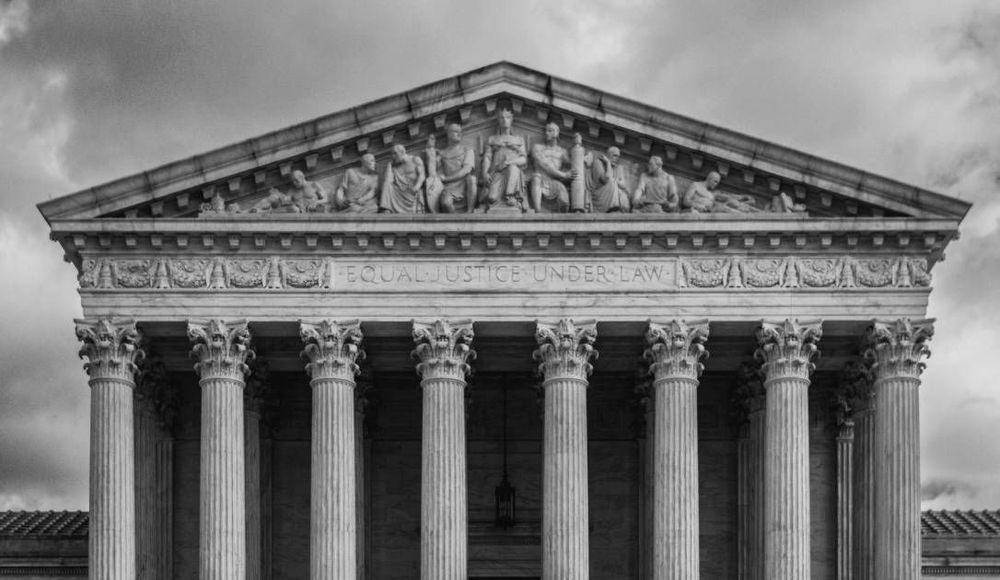
Supreme Court to consider whether geofence warrants are constitutional
The Supreme Court said Friday that it will hear a case challenging the constitutionality of geofence warrants, which let law enforcement compel companies to provide the location data of cell phones at specific times and places.
The case centers on the trial of Okello Chatrie, a Virginia man who pleaded guilty to a 2019 robbery outside of Richmond and was sentenced to almost 12 years in prison for stealing $195,000 at gunpoint.
Police probing the crime found security camera footage showing a man on a cell phone near the credit union that was robbed and asked Google to produce anonymized location data near the robbery site so they could determine who committed the crime. They did so, providing police with subscriber data for three people, one of whom was Chatrie. Police then searched Chatrie’s home and allegedly surfaced a gun, almost $100,000 in cash and incriminating notes.
Chatrie’s appeal challenges the constitutionality of geofence warrants, arguing that they violate individuals’ Fourth Amendment rights protecting against unreasonable searches.
Chatrie’s lawyers petitioned the Supreme Court to hear the case, noting that police are using geofence warrants frequently even as lower courts have had divided opinions on their constitutionality..
According to Chatrie’s lawyers’ petition to the Supreme Court, Google saw a 1,500% increase in geofence warrant requests from 2017 to 2018. An increase of an additional 500% occurred in 2019, according to Harvard Law Review. The warrants are still used today.
“Tech companies have had no choice but to develop protocols, without judicial guidance, for balancing law enforcement interests with user privacy,” Chatrie’s lawyers wrote.
After Chatrie challenged the geofence warrant used in his case as unconstitutional, a federal judge agreed the search likely violated the Fourth Amendment, but declined to prevent prosecutors from introducing the evidence collected from the warrant.
Chatrie appealed to the 4th Circuit Court of Appeals, where a panel of judges split 2-1 in favor of the warrant’s constitutionality, citing the fact that Chatrie gave Google his data without objection.
U.S. Solicitor General David Sauer asked the Supreme Court to decline to hear the case.
In his petition, Sauer noted that Google has changed its data storage policies so that police are no longer able to get the type of information they gleaned from the Chatrie geofence warrant, giving the case “limited prospective importance.”
However, a ruling would be relevant for other tech companies that have not moved to encrypt their data. Law enforcement also can still issue Google geofence warrants for cases originating prior to December 2023, when the company changed its policy to only store location data for three months.
Orin Kerr, a prominent law scholar at Stanford Law School, said on X that even though the type of geofence warrant used in the Chatrie case is becoming less common due to Google’s policy change, the ruling could still be relevant to other cases involving police searches of large databases.
Sauer, the U.S. solicitor general, argued that geofence warrants are appropriate because “individuals generally have no reasonable expectation of privacy in information disclosed to a third party and then conveyed by the third party to the government,” he wrote.
Chatrie had turned on location history in Google, “thus relinquishing any privacy right in that information,” Sauer wrote.
A ruling is expected by early July.



Suzanne Smalley
is a reporter covering digital privacy, surveillance technologies and cybersecurity policy for The Record. She was previously a cybersecurity reporter at CyberScoop. Earlier in her career Suzanne covered the Boston Police Department for the Boston Globe and two presidential campaign cycles for Newsweek. She lives in Washington with her husband and three children.