

US sanctions Cambodian senator for millions earned through scam compounds
A Cambodian senator and longtime ally of the country’s leader was sanctioned by U.S. officials on Thursday for his involvement in scam compounds responsible for millions of dollars in American financial losses.
The Treasury Department said Cambodian senator Kok An was being sanctioned alongside 28 others involved in his scam center operation.
“Southeast Asian scam operators within this network have stolen millions of dollars from U.S. victims while operating under the protection of Kok An and his political connections,” U.S. officials said.
“Kok An and his affiliates’ network of scam centers, operating out of casinos and office parks retrofitted for fraudulent activity, launder victims’ funds and provide a base to target U.S. citizens and commit human rights abuses with impunity.”
Kok An has been a politically connected businessman in Southeast Asia for decades, using his longstanding ties to former Cambodian Prime Minister Hun Sen and current leader Hun Manet to grow his empire of casinos, hotels and businesses.
The U.S. sanctions come after Thailand issued an arrest warrant for Kok An last July and raided dozens of his properties in towns along the border between Cambodia and Thailand. Thai police seized assets worth more than $33.8 million, the Bangkok Post reported at the time.
Kok An’s flagship company is Crown Resorts, which owns casinos, resorts and hotels across Poipet, Sihanoukville, Bavet and other Cambodian border cities. U.S. officials said the compounds have been converted into facilities used by criminal organizations for “digital asset investment fraud and other scams.”
“Victims of human trafficking taken to these facilities have reported that they and thousands of others are exploited by fraudsters based at the properties and forced to steal money from victims, including Americans, to repay them for the costs of being abducted,” Treasury officials said.
The sanctions cite a report from the State Department that said trafficking victims from Kok An properties were beaten if they did not contact a certain number of scam victims each day.
Kok An collects rental income from the scam operators and provides a range of other services to workers there, including uniformed security. Almost all of the major scam compounds in Cambodia are connected to casinos, most of which launder the proceeds of the scams, U.S. officials said.
The Treasury Department included several of Kok An’s associates in the sanctions. Rithy Raksmei, owner of K99 Group, allegedly operates several casinos that have housed trafficking victims. His brother was married to one of Kok An’s daughters.
Several of Rithy Raksmei’s properties have housed scam workers dating back to 2019 and the Treasury Department said they “have also reportedly been the sites of unlawful detentions, beatings, and deaths of their occupants.”
The sanctions name other associates including Burmese nationals Aik Paung and Sai Aung Linn, Cambodian casino owner Luo Hong as well as a bank called Heng Feng Cambodia.
Investigators found that Luo Hong played a role in facilitating the transfer of scam funds from U.S. bank accounts to bank accounts abroad.
The Secret Service said several people were scammed into handing over money thinking it was going toward an investment in cryptocurrency. The money was instead sent to bank accounts of people in the U.S. who then sent the money to bank accounts in Cambodia.
At least $1.3 million was traced to bank accounts belonging to Luo Hong. Eight U.S. residents have pleaded guilty to their involvement in the scheme, including a money launderer named Daren Li who also pleaded guilty but cut off his ankle monitor and fled the U.S. in December.
Daren Li said in a plea agreement last year that $73.6 million worth of victim funds were deposited into bank accounts his team controlled before they were sent elsewhere.
U.S. agencies have repeatedly targeted Cambodian leaders for their role in the scam center economy, which has generated about $44 billion for Myanmar, Cambodia and Laos. Human rights groups and the State Department believe there are hundreds of scam centers across Cambodia.
The Treasury Department sanctioned another Cambodian senator and billionaire, Ly Yong Phat, in 2024 for his ownership of several hotels, resorts and casinos that house cyber scam operations. One of Kok An’s daughters is married to one of Ly Yong Phat’s sons.
In a bit of painful irony, both Kok An and Ly Young Phat voted two weeks ago in support of a new Cambodian law that created harsh sentences for scam center operators and workers.
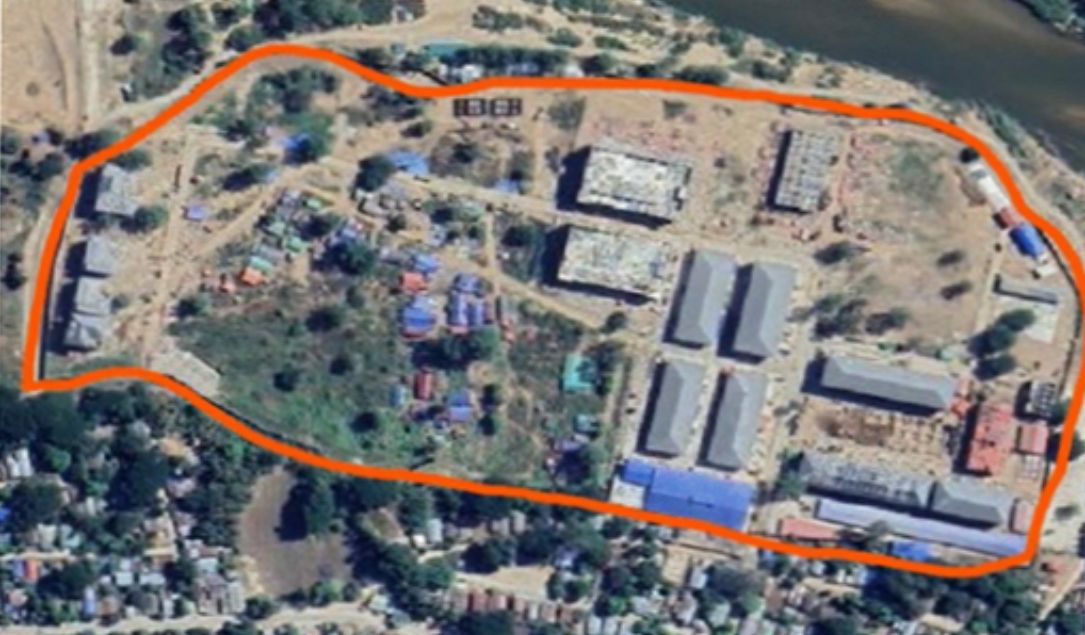
An image of a Burmese scam compound highlighted by the Justice Department.
Strike Force actions
Thursday’s sanctions were launched alongside the Scam Center Strike Force, a DOJ-led government initiative designed to coordinate law enforcement’s response to digital scams. More than $16 billion was stolen from U.S. citizens last year through scams related to fake investments or romantic relationships.
In addition to the sanctions on Kok An, the Scam Center Strike Force announced several other actions aimed at the schemes, including the seizure of 503 web domains used to legitimize fake crypto investment companies.
The Justice Department charged two Chinese nationals, Huang Xingshan and Jiang Wen Jie, with wire fraud on accusations that they ran cryptocurrency investment fraud operations at the Shunda compound in Min Let Pan, Myanmar.
The compound was shuttered in November and U.S. officials investigated the facility alongside Thai law enforcement, obtaining troves of information on scam operations in the region.
The raids on Shunda uncovered evidence that those held in scam centers posed as bank workers or U.S. law enforcement and would call victims with urgent messages demanding payment.
Huang Xingshan and Jiang Wen Jie fled to Cambodia and were preparing to open a new scam compound in Myanmar before they were arrested in Thailand in January.
U.S. officials also shut down a Telegram channel called “Pogo Job Hiring” that had more than 6,000 members and posted ads for jobs in Cambodia that sought out people willing to work nights and those that had American accents.
The State Department released a $10 million reward for information related to another scam compound sanctioned last year and a $4 million reward for Daren Li — who was sentenced to 20 years in prison in February.
As of March 2026, the FBI and other agencies said they have notified 8,935 victims of cryptocurrency investment fraud since launching efforts to address the scams in January 2024.
“Some victims have reported to law enforcement that — prior to being notified by the FBI about the scam — they were in the process of liquidating their 401K, selling their home, or obtaining a sizable loan,” the DOJ said.
“One elderly victim was surviving on disability pay; he had already paid the scammers $1,200 and would have cut into money he needed for food to pay more. Each of the 503 .com domains seized was identified by a victim contacted by Operation Level Up and involved in laundering that victim’s cryptocurrency funds.”
President Donald Trump signed an executive order in March mandating the U.S. government take more robust action to address the Southeast Asian scam center issue.
A U.S. official warned last month that despite recent law enforcement action, China has tacitly supported the continuation of scam center compounds as long as Chinese citizens are not targeted.



Jonathan Greig
is a Breaking News Reporter at Recorded Future News. Jonathan has worked across the globe as a journalist since 2014. Before moving back to New York City, he worked for news outlets in South Africa, Jordan and Cambodia. He previously covered cybersecurity at ZDNet and TechRepublic.