
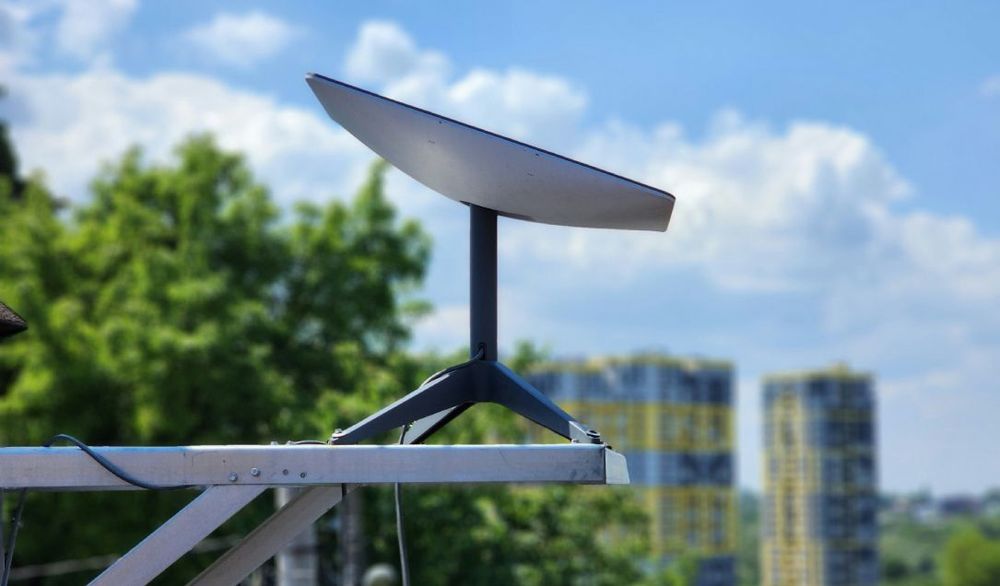
Ukraine tightens controls on Starlink terminals to counter Russian drones
Ukraine has rolled out a verification system for Starlink satellite internet terminals used by civilians and the military after confirming that Russian forces have begun installing the technology on attack drones.
The Ukrainian government has introduced a mandatory “whitelist” for Starlink terminals, under which only verified and registered devices will be allowed to operate in the country. All other terminals will be automatically disconnected, according to a statement from Mykhailo Fedorov, recently appointed as the country’s defense chief.
The move is aimed at countering Russian unmanned aerial vehicles that Kyiv says are now being controlled in real time via Starlink connections — making them harder to detect, jam or shoot down.
“Russian drones equipped with Starlink are difficult to intercept,” Fedorov said earlier this week. “They fly at low altitude, are resistant to electronic warfare, and can be controlled by operators over long distances in real time.”
The whitelist is being implemented by the Ministry of Defense in cooperation with SpaceX, which operates Starlink’s low-Earth-orbit satellite constellation.
Fedorov confirmed on Wednesday that citizens have already begun registering their terminals, adding that the measure is currently the only technical solution available to prevent Russia from exploiting the system.
“This is a forced step by the government to save Ukrainian lives and protect our energy infrastructure,” he said.
Under the new system, civilians will be able to register their terminals at local government offices, while businesses will be able to verify devices online through Ukraine’s e-government services. Military units will use a separate secure registration channel and will not be required to disclose account details, according to Ukraine’s Ministry of Defense.
At the end of January, Ukraine detected a Russian drone using Starlink connectivity during operations over Ukrainian territory. Kyiv then contacted SpaceX to address the issue, though details of the emergency measures were not officially disclosed.
Ukrainian military outlet ArmyInform reported that one step involved setting a maximum speed at which Starlink terminals can function, citing a preliminary limit of around 75 kilometers per hour. Russian strike drones typically fly faster than that, which would prevent operators from controlling them in real time, according to the report.
As an additional safeguard, the Defense Ministry said authorized terminals inside Ukraine will operate only in stationary mode or at low speeds while in motion.
Starlink has played a key role in Ukraine’s war effort, providing internet access when much of the country’s telecommunications infrastructure was damaged or destroyed. Officials say more than 50,000 Starlink terminals are currently operating in Ukraine.
Fedorov praised Elon Musk for the rapid activation of Starlink service in Ukraine at the start of Russia’s full-scale invasion in February 2022, calling it critical to the country’s resilience.
“Western technologies must continue to protect civilians and the democratic world,” Fedorov said, “not be used for terror and the destruction of peaceful cities.”



Daryna Antoniuk
is a reporter for Recorded Future News based in Ukraine. She writes about cybersecurity startups, cyberattacks in Eastern Europe and the state of the cyberwar between Ukraine and Russia. She previously was a tech reporter for Forbes Ukraine. Her work has also been published at Sifted, The Kyiv Independent and The Kyiv Post.