
Iranian influence operation using fake personas to deceive US Instagram users disrupted, Meta says
Meta said Wednesday it disrupted an influence operation linked to Iran that used “sophisticated fake personas” on Instagram to build relationships with U.S. users before introducing political messaging.
The network used accounts posing as journalists, commentators and ordinary people to engage users and gradually introduce political narratives, the company said. A second layer of accounts amplified posts to help spread the messaging.
The personas were given detailed backstories and occupations — including a political scientist, a women’s rights activist and a satirical cartoonist — and used multiple AI-generated profile photos in an attempt to appear credible.
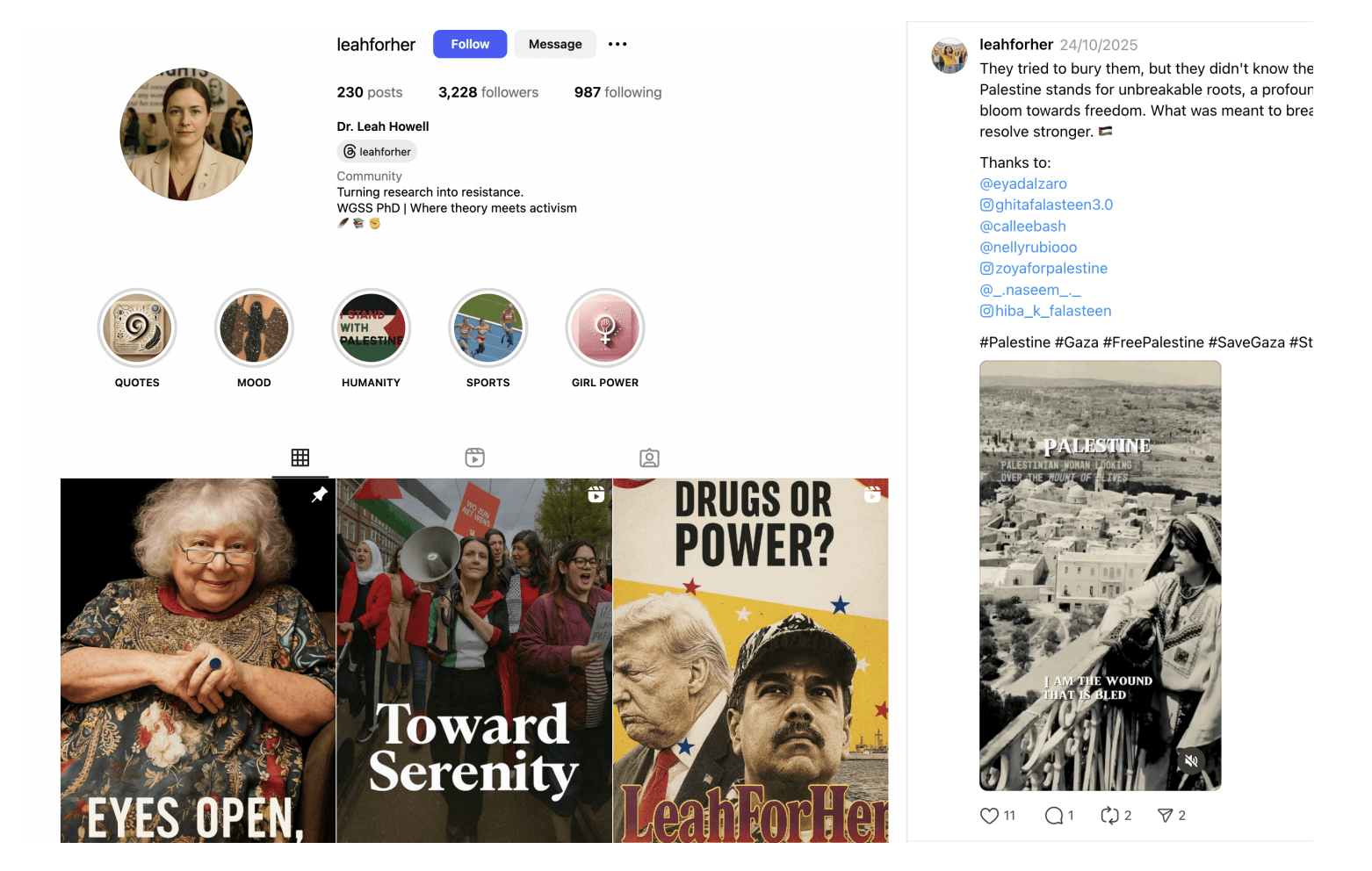
An example of an Instagram account believed to be part of the Iranian influence operation. Credit: Meta
According to Meta, the network also built what appeared to be grassroots media brands, mixing political messaging with general news and nonpolitical content to make the accounts look more legitimate and less overtly coordinated.
The operation primarily targeted English-speaking audiences in the U.S. and posted content critical of Israel and U.S. policy in the Middle East, themes commonly seen in previous Iranian influence campaigns, the company said.
“These types of operations often try to build credibility first,” said David Agranovich, Meta’s director of global threat disruption, during a briefing with reporters. “They engage with people, build relationships and then introduce messaging designed to influence public conversations.”
Meta said it removed about 300 accounts and pages across Facebook and Instagram before the network had gained a large following. About 41,000 accounts followed the Instagram personas, which received minimal engagement from real users.
The operation began on X in 2024 before expanding to Facebook and Instagram in the summer of 2025, Meta said. It detected and disrupted the network late last year through coordinated behavior across accounts and links to previously identified Iranian influence operations.
Meta also said it has not yet observed significant new influence campaigns tied to the recent escalation between Iran, Israel and the U.S. following airstrikes on Iranian targets.
“In situations like this, influence operations don’t usually appear overnight,” Agranovich said. “It often takes time for actors to pivot their messaging and build out the infrastructure needed to run these campaigns.”

Alexander Martin
is the UK Editor for Recorded Future News. He was previously a technology reporter for Sky News and a fellow at the European Cyber Conflict Research Initiative, now Virtual Routes. He can be reached securely using Signal on: AlexanderMartin.79