
British government sanctions Russian and Chinese groups over information warfare
The United Kingdom imposed new sanctions Tuesday against several Russian and Chinese organizations accused of undermining the West through both cyberattacks and influence operations.
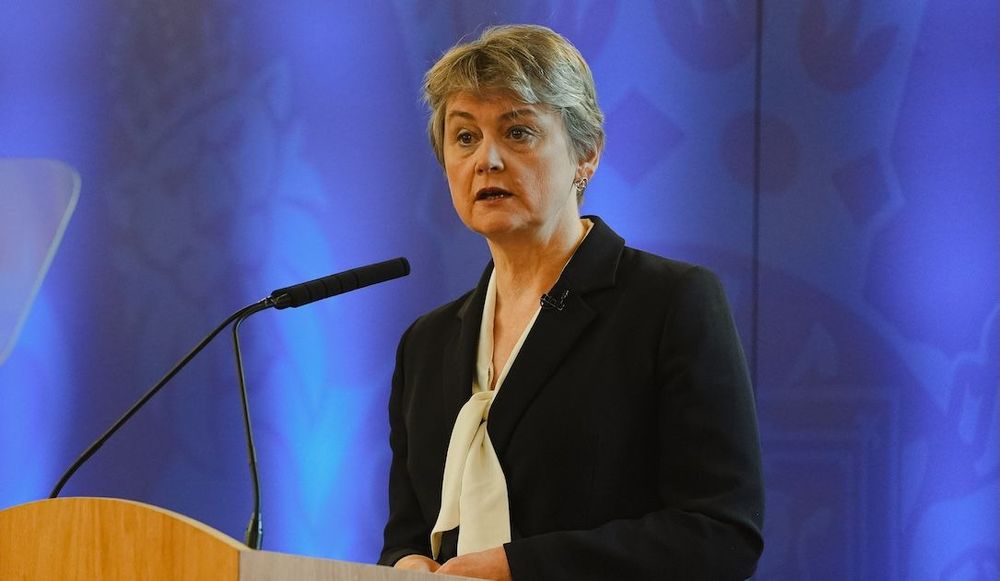
Foreign Secretary Yvette Cooper used the centenary of the Locarno Treaties — signed in the wake of World War I in an ultimately failed attempt to ensure peace on the continent — to call for Europe to adopt a “new and reinvigorated and more agile form of multilateralism” to counter “ever more complex hybrid security threats.”
In a speech at the Locarno suites in the Foreign Office, Cooper announced sanctions on seven Russian individuals and influence networks including the Telegram channel Ryber and its co-owner Mikhail Zvinchuk, an organization called Pravfond described by Estonian intelligence as a front for the GRU, and the Centre for Geopolitical Expertise, a Moscow-based think tank founded by Aleksandr Dugin.
Of the seven entities, Zvinchuk and his company Rybar — previously funded by the deceased Yevgeniy Prigozhin — currently feature in the U.S. Rewards for Justice program, with a reward of up to $10 million for information about them.
Pravfond had previously been exposed in a joint report by by the Organized Crime and Corruption Reporting Project (OCCRP) and Lithuanian public broadcaster LRT, and has been used to fund the legal defense of individuals accused of working for the Kremlin as well as the Euromore and Golos media outlets now also sanctioned by Britain.
The new sanctions come a week after the British government announced it was sanctioning the entirety of Russia’s military intelligence agency, the GRU, after a public inquiry concluded it was responsible for a deadly nerve agent attack on British soil in 2018.
Cooper also announced sanctions against two Chinese technology companies known as i-Soon and Integrity Technology Group. Both were accused of engaging in and facilitating cyber operations targeting the U.K. and its allies, including unspecified public sector IT networks in Britain.
Integrity Tech was previously accused in September 2024 by then FBI Director Christopher Wray with running a botnet used to facilitate cyber espionage operations targeting “everyone from corporations and media organizations to universities and government agencies.” It was sanctioned by the U.S. Treasury Department this January.
Several i-Soon employees had previously been charged in the United States, alongside two officers of the Ministry of Public Security, with conducting computer intrusions against private sector and government targets in the U.S. and across Asia. The charges followed a trove of leaked documents about the company appearing online.
Tackling hybrid threats
“Across Europe we are witnessing an escalation in hybrid threats — from physical through to cyber — designed to weaken critical national infrastructure, undermine our interests and interfere in our democracies all for the advantage of malign foreign states,” Cooper told the audience of European diplomats and dignitaries.
She argued against both of the dominant views about how to respond to this escalation, stating it was not true that “only great power politics matters” and that European countries should not double down on the multilateral architecture established following the Second World War. Instead, Cooper said, European states needed to build new coalitions sharing intelligence, cybersecurity and defense efforts to ensure their own safety.
The message comes in the wake of President Donald Trump’s new national security strategy, which explicitly set out that the United States expects Europe to assume responsibility for its own defense. Cooper said: “For too long, Europe has relied too heavily on US support to protect ourselves from the threats to Euro-Atlantic security. And we can do so no more. Europe must step up.”
The most acute security threat facing Europe “right now lies in Russia’s war against Ukraine,” said Cooper, stating the conflict has extended well beyond Ukraine’s borders: “We’ve seen sabotage in European cities. Reckless breaches of NATO airspace. Relentless cyber-attacks. A full spectrum campaign. To test us. To provoke us. And to destabilise us.”
Britain’s interests
Tuesday’s sanctions are the latest of hundreds that the British government has imposed on a range of entities associated with Russia and a much smaller but growing number of organizations connected to China’s cyber ecosystem.
One of the intentions of the sanctions regime is that by freezing assets and restricting access to the British financial system, the costs incurred by hostile actors make it increasingly difficult for them to operate. Academic research suggests that while these sanctions are likely having some impact on cyber actors and Russia’s ability to continue to wage war on Ukraine, there are too many workarounds available for sanctions to themselves prevent hostile activities.
The other intention is exposing and potentially embarrassing the targets — “naming and shaming” them — although this too has been described as falling short of achieving a substantial strategic effect. A growing number of individuals, including Lord Dannatt, the former head of the British Army, speaking to Recorded Future News, and the former cabinet secretary Mark Sedwil writing for the Independent newspaper on Tuesday, have criticized the government’s current approach and called for a more proactive response.
Sedwill wrote: “Putin regards the UK as Russia’s most implacable adversary. Let us embrace that. Britain should lead this hybrid campaign for Europe. Our world-class intelligence services, special forces and cyber force can deliver strategic effects through precision operations.
“Our strategic culture is not paralysed by fear. We understand that credible deterrence is offensive, not just defensive, striking where Russia is vulnerable, forcing them to defend everywhere, imposing costs through means difficult to predict. This is a hybrid war of manoeuvre. Europe needs a nation willing to spearhead it. Britain should be that nation.”



Alexander Martin
is the UK Editor for Recorded Future News. He was previously a technology reporter for Sky News and a fellow at the European Cyber Conflict Research Initiative, now Virtual Routes. He can be reached securely using Signal on: AlexanderMartin.79