
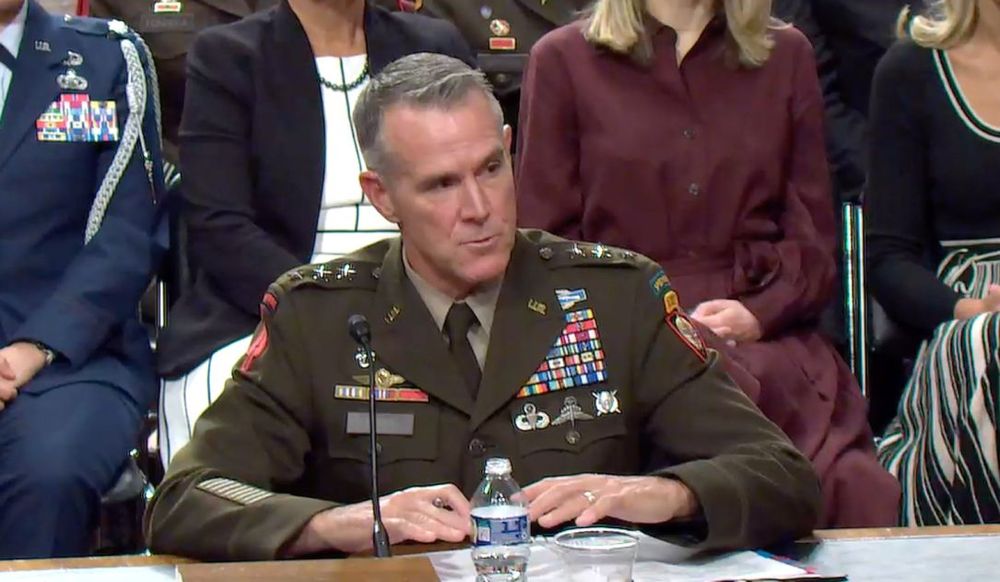
NSA, Cyber Command nominee defends record during Senate hearing
The Trump administration’s nominee to lead U.S. Cyber Command and the National Security Agency on Thursday pushed aside questions about his lack of digital warfare and intelligence experience, saying he would draw on his unique military background and insights from current officials.
“For decades, I have had the opportunity to be a leader, consumer, enabler, generator and integrator of the intelligence and operational capabilities of NSA and Cyber Command,” Army Lt. Gen. Joshua Rudd, the administration’s pick to serve as the next “dual-hat” chief of both organizations, said in his opening statement before the Senate Armed Services Committee.
He later added that the “reliance upon both signals intelligence and cyber capabilities are absolutely indispensable to our warfighters,” including in his current post as deputy commander of U.S. Indo-Pacific Command.
“We look at it every day. We operationalize it. We integrate it. And we factor it into every one of our decisions,” according to Rudd who spent most of his military career in special operations. “If you go further back in my background, certainly that holds true different theaters, different problem sets, but that's been a continuous theme throughout my career.”
If confirmed, Rudd would take over two entities that have been without a permanent leader since far-right provocateur Laura Loomer initiated a push to force out its last chief and has seemingly sunk a number of other senior officials.
Lawmakers did not press Rudd for his views on recent, high-profile U.S. military operations in Iran and Venezuela where the command has been name-checked, and instead questioned his lack of technical bonafides.
“I’m confident that the incredible talent at CYBERCOM-NSA will provide great advice,” Rudd told the panel. “I'm confident that, if confirmed, I can continue to lead and enable those two organizations to provide the best support to our combat commanders in the joint force, writ large.”
Sen. Angus King (I-ME), however, expressed disappointment after Rudd hedged during a series of questions about his views on creating deterrence in cyberspace.
“I'm confused because you're nominated to be the top cyber officer in the United States government, and you don't have any opinion on cyber policy,” King said. “Are you simply a lever puller? I really don't understand, because this is a critical area of defense. It's a vector of attack on this country that's going on as we sit here today.”
Rudd also was repeatedly asked about the shared leadership arrangement between Cyber Command and the NSA, a topic that dogged both organizations for years and has cropped up several times during Trump’s two stints in the Oval Office.
Rudd said that, as a consumer, he has seen an “effectiveness that fosters integration and speed” with the arrangement.
However, he vowed he would seek to be “objective about that as that comes up, or if it continues to come up as a topic … I'll seek great insight from not only the two organizations, but the customer as well, if you will. How does it work best?”
The three-star also promised to “thicken and deepen” relationships across industry and academia to bolster the command’s workforce to meet rapidly evolving digital threats.
“Cyber is the domain that we're active in right now. Some could say we're at war right now in that domain. I don't think that's an unfair characterization.”
Rudd is unlikely to face too much resistance from the GOP-controlled Senate. He will appear before the Senate Intelligence Committee, which shares jurisdiction over his nomination, later this month.
Current acting Cyber Command and NSA chief Army Lt. Gen. William Hartman is slated to retire early next month. Barring any speedbumps in his next hearing, or a lawmaker placing a hold on his nomination, Rudd could be confirmed in the next three weeks.


Martin Matishak
is the senior cybersecurity reporter for The Record. Prior to joining Recorded Future News in 2021, he spent more than five years at Politico, where he covered digital and national security developments across Capitol Hill, the Pentagon and the U.S. intelligence community. He previously was a reporter at The Hill, National Journal Group and Inside Washington Publishers.