
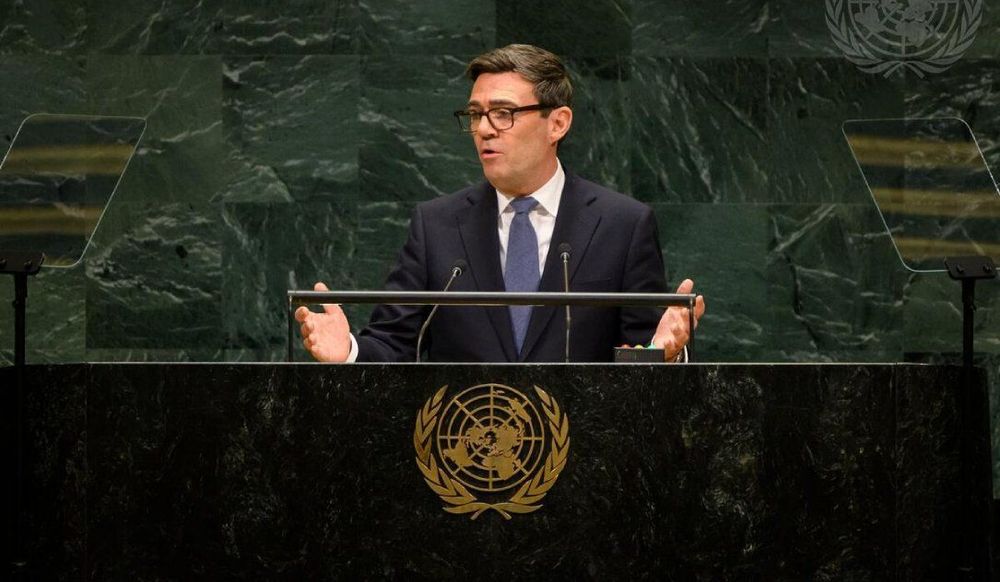
Burnham announces plan for new UK center to fight disinformation
British Prime Minister Andy Burnham said Tuesday he has ordered security chiefs to begin work on a new national center ”to detect, attribute and disrupt” hostile state disinformation.
Speaking to the U.N. General Assembly, in his first address there as prime minister, Burnham said the United Kingdom would use its experience to help other countries.
“As more elections approach across Europe, more nations are grappling with these issues – some for the first time,” he said. “So we’re ready to share our understanding of how these actors work, and how we can respond — because this is vital for our collective security and resilience.”
The move could consolidate work now spread across several government departments, though Burnham gave few details about the ultimate shape of what he called the National Centre for Information Defence.
The Cabinet Office is understood to be leading the initial work, with intelligence agencies, other government departments, law enforcement and social media companies involved in determining how the center could operate.
His announcement comes as European governments increasingly describe Russian cyberattacks, sabotage and influence operations as part of a broader hybrid campaign.
Earlier this year, Britain and the European Union imposed sanctions on Russian cyber and disinformation actors, including a media outlet accused of interfering in elections in Moldova and Armenia.
Experts fear artificial intelligence is lowering the cost of running such operations. State-linked actors in Iran and China, along with a private Israeli firm, have begun using largely autonomous AI systems to run influence campaigns with limited human involvement, The New York Times reported last week.
Sophie Williams-Dunning, a research analyst at the Royal United Services Institute think tank, told Recorded Future News that Britain “has been overdue a more coherent strategic response to this threat.”
“The threat environment has vastly changed, and the government’s response has so far been split across several departments,” she said.
But she cautioned there was “a real difference between a centre inside the Cabinet Office and an agency accountable to Parliament.”
“I’d hope this is meant to be the foundation for the latter, not one more unit similar in resourcing to the ones already out there,” she said.
A new center “can mean a lot of different things,” wrote Joe Devanny, a senior lecturer at King’s College London, “from largely rebadging existing effort, to a significant rethink of your approach.”
He said it was unclear where on the spectrum the new body would sit, and whether those details had already been worked out.
A spokesperson for the prime minister’s office said more information would be released in due course.
The Moscow playbook
Burnham accused Russian agencies of using bots and fake websites, falsifying newspaper articles, copying the branding of 28 British organizations — including universities and the BBC — and amplifying far-right narratives.
The government’s work is also looking at how to strengthen the country’s ability to build community resilience in identifying and combatting disinformation, in the wake of reports linking riots in Belfast and Southampton to foreign agitation.
“The Kremlin spends around £1.3 billion ($1.7 billion) each year on manipulating information,” said the prime minister. “We’re talking about an insidious campaign that reaches into people’s homes and twists what they feel about their own country and community – creating a narrative of decline, stoking division and sowing despair.”
He said Britain had “given too much ground” over the past decade to those seeking to promote what he called a “negative, corrosive narrative” about the country.
“Well, no more,” Burnham said. “We are going to face the new decade in a different way — with our eyes wide open. We are going to be much prouder in standing up for our values and the rule of law.”
Britain has already created a criminal offense specifically aimed at foreign interference under the National Security Act 2023. Williams-Dunning said the offense has proved difficult to use so far.
“There’s a high evidentiary threshold, particularly on proving foreign orchestration,” she said. “That’s one reason the offence has been hard to use so far. One of the first tasks for this centre will be finding a way to actually implement it.”
France and Sweden both have agencies tasked with countering foreign disinformation and influence operations. France’s Viginum, created in 2021, offers one model for a dedicated body focused specifically on foreign information operations.
Its deputy head, Anne-Sophie Dhiver, told Recorded Future News last year that Viginum acts only against foreign operations involving fake accounts, bots or other coordinated inauthentic behavior.
She said it does not investigate domestic actors or determine whether individual claims are true, being wary of provoking comparisons to George Orwell’s Ministry of Truth — an allegation that has been made about Britain’s existing units.
Williams-Dunning said Viginum’s approach was narrower than what Burnham has described: “Viginum doesn't have an explicit mandate for disruption — its main effort is coordination, detection and public attribution, including debunking and prebunking.”
Burnham’s “language around this centre suggests something closer to defending forward,” she added.
It’s not yet clear what disruption would mean in practice for the new National Centre for Information Defence, nor what powers it would have to carry that disruption out.
London has previously used sanctions, domain seizures, law enforcement action and regulatory powers against foreign influence networks. These authorities are spread across a wide range of government bodies, from the Foreign Office to the Treasury.
British authorities have also previously used offensive cyber capabilities against Islamic State propaganda networks, powers that now sit under the National Cyber Force.



Alexander Martin
is the UK Editor for Recorded Future News. He was previously a technology reporter for Sky News and a fellow at the European Cyber Conflict Research Initiative, now Virtual Routes. He can be reached securely using Signal on: AlexanderMartin.79