

Russian charged with spying on Palantir employees for Moscow
A Russian national recruited through Telegram has been charged in the United States with acting as a Moscow agent in a surveillance campaign targeting employees of a defense technology company, understood to be Palantir Technologies.
The alleged spying operation involved electronic surveillance, detailed dossiers on employees and their families, and, in one case, a nearly 30-mile pursuit of a female worker who ultimately sought help from a police patrol car.
Igor Andreevich D’iu was “recruited, directed, and funded by the Russian government,” according to Roman Rozhavsky, an assistant director in the FBI’s Counterintelligence and Espionage Division.
D’iu entered the U.S. illegally from Mexico — after travelling there from Russia via Istanbul — and was charged this week with conspiring to act as an agent of Russia, acting as an agent of a foreign government without notifying the attorney general, interstate stalking and identity document fraud.
The indictment does not identify Palantir by name, but describes the target company as a large, publicly traded technology and defense business whose software Ukraine is using during its war with Russia. Palantir did not respond to a request for comment.
Images released by the Department of Justice show photographs which D’iu took of laptop screens at outdoor café tables at a Starbucks and Verve Coffee Roasters, both of which are a short walk from Palantir’s offices in Palo Alto.
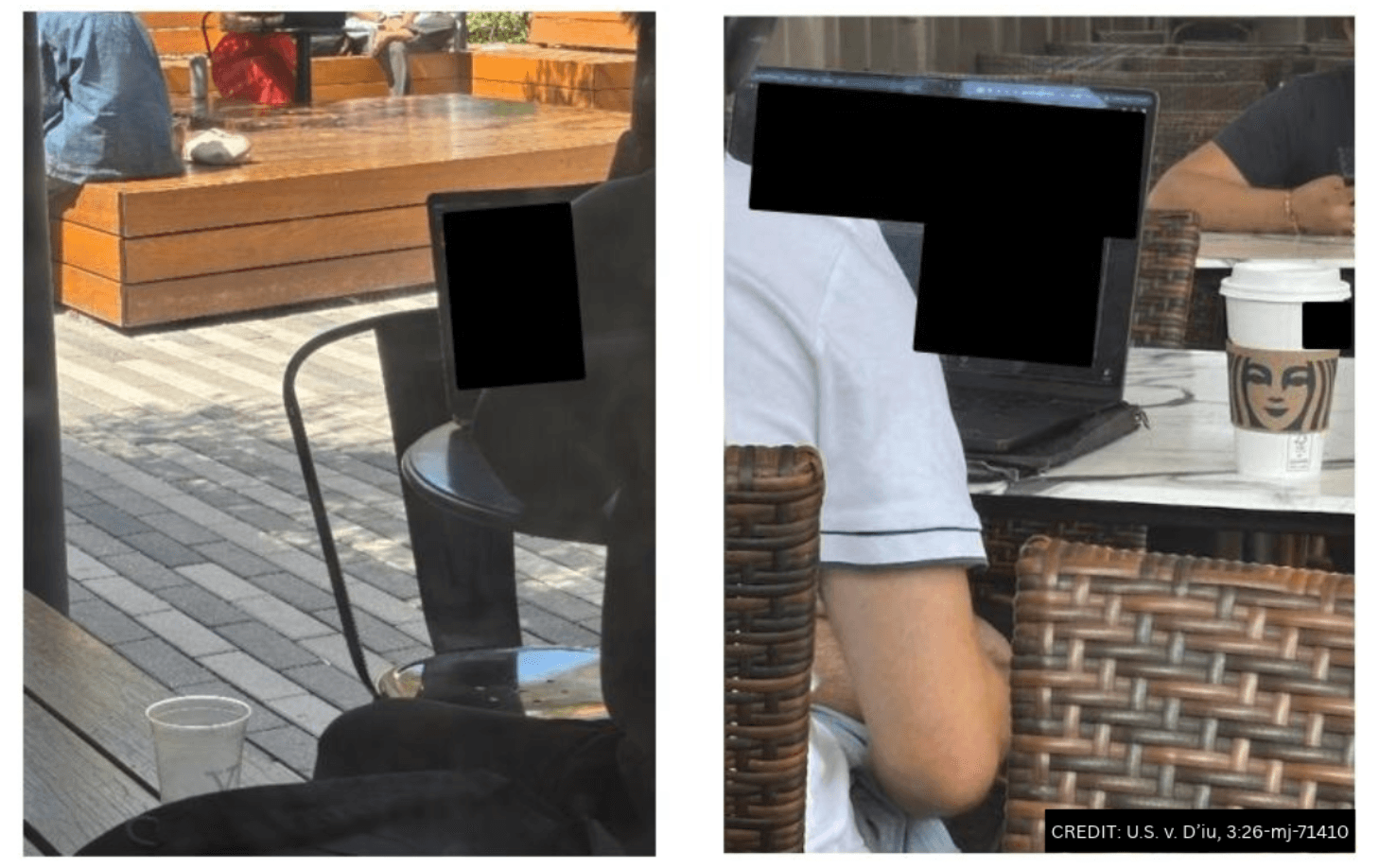
Photos D'iu took of employees' computers. Images: Department of Justice
Federal court documents allege that D’iu photographed employees’ laptop screens at these cafés and also carried a laptop and Wi-Fi equipment which his handlers could control remotely to “collect data from any Company employees in range.”
His assignments lasted from a few minutes to three hours long. In one case it involved leaving his laptop at a specific location in the middle of the night before retrieving it. The filings do not say whether any employee data was obtained in these operations.
D’iu’s handlers also provided him with “target packages” containing detailed profiles of specific Palantir employees, including one executive, listing those employees’ relatives, their career histories and assessments of their “strengths and weaknesses,” alongside home addresses.
His tasks included posing as a food delivery driver while knocking on employees’ doors to verify who lived there. According to investigators, all four addresses supplied in messages sent by D’iu’s handlers belongs to company employees.
Read more: Fears grow of Russian spies turning to industrial espionage
Law enforcement began investigating D’iu after he followed a female Palantir employee for nearly 30 miles from the Palo Alto office toward San Francisco, making illegal turns and running a red light as she tried to evade him.
The woman called 911 and sought help from a police patrol car near San Francisco. A police report described her as being in a state of emotional distress.
Police tracked down D’iu’s vehicle. Palantir provided security footage that showed his rented Lexus outside of the company’s office on the days preceding the stalking incident, and the footage potentially showed two other incidents in which he attempted to follow other employees.
After contacting D’iu through a driving license he provided to rent the car, police said the man claimed he had followed the woman because he wanted to ask her on a date.
D’iu subsequently changed cars, bought a new SIM card for his phone and left California on his handlers’ orders before returning to the Bay Area several weeks later.
His handlers also arranged for forged identity documents to be shipped to him from Kyrgyzstan, including a California ID and a genuine U.S. passport stolen from a New York woman and altered with his photograph. Both were intercepted by the FBI.
Investigators say they traced him in part through accounts in his own name which revealed Google searches for the company, for employees’ home addresses and for ways to avoid U.S. border checkpoints.
FBI agents searched his home and recovered two laptops, two iPhones, Wi-Fi equipment, forged documents, employee dossiers and $18,035 in cash.
Questioned by investigators, D’iu said his handlers told him he was working for “the Motherland” and that the company was being targeted because it was helping Ukraine fight Russia.
As compensation for his work, D’iu received three payments of $15,000 in cash, collecting the money through couriers who used dollar bills as identification tokens, according to the affidavit.
To arrange each handover, D’iu would photograph a bill’s serial number and send it to his handlers. The courier would then check the number of the bill he held against the photograph to confirm they were handing the cash to the right person.
Britain’s National Crime Agency has documented the same token system among cash couriers working for Russian money-laundering networks in the United Kingdom.
The FBI said the case is consistent with Russian intelligence services’ increasing reliance on criminals and other “disposable agents” for clandestine operations abroad.



Alexander Martin
is the UK Editor for Recorded Future News. He was previously a technology reporter for Sky News and a fellow at the European Cyber Conflict Research Initiative, now Virtual Routes. He can be reached securely using Signal on: AlexanderMartin.79