
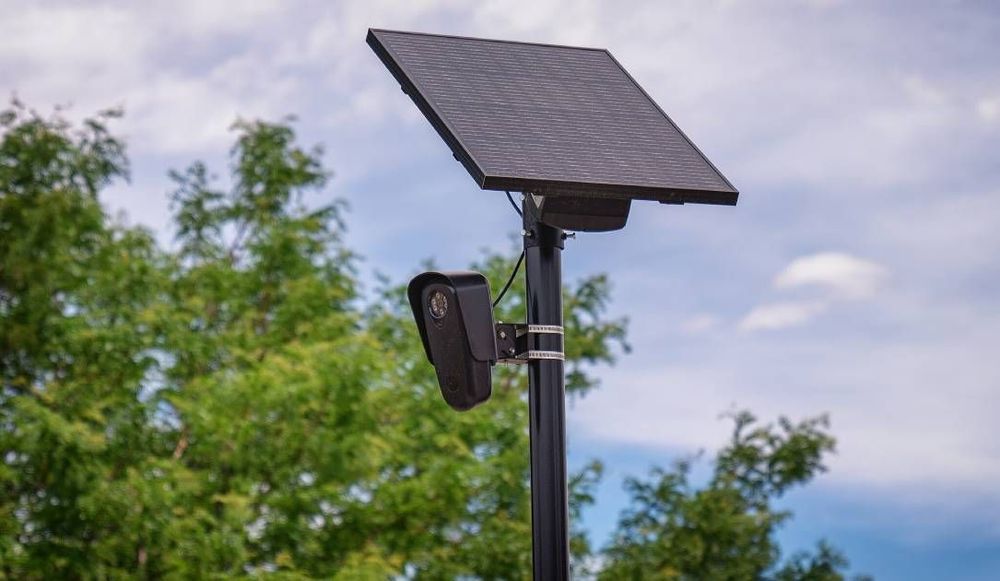
Judge dismisses case alleging use of Flock cameras in Virginia city is unconstitutional
A Virginia federal judge ruled Tuesday that the warrantless use of 176 Flock automated license plate reader (ALPR) cameras in Norfolk, Virginia, is constitutional and dismissed a case seeking to eradicate them.
Plaintiffs in the case had argued that the cameras violated their Fourth Amendment rights protecting against unreasonable search and seizure, but Judge Mark Davis ruled that the camera network is not extensive enough to be deemed unconstitutional.
The case has been closely watched at a time when the increasing prevalence of license plate cameras — and accompanying abuses — have led to community backlashes nationwide.
In recent months, cities as far-flung as Austin, Texas, Cambridge, Massachusetts, and Flagstaff, Arizona, have terminated their contracts with Flock Safety. Officials in those cities have cited privacy concerns as well as documented instances of the cameras being used for immigration enforcement and to track a woman who had an abortion.
The Institute for Justice, a nonprofit which brought the case on behalf of two Hampton Roads residents, said it will appeal.
In his 51-page opinion, Davis frequently cited two landmark privacy cases.
In the Carpenter v. United States case, the Supreme Court ruled 5-4 that accessing historical mobile device location data requires a warrant under the Fourth Amendment.
The 4th Circuit Court of Appeals ruled in the Leaders of a Beautiful Struggle v. Baltimore Police Department case that the Baltimore Police Department’s use of planes to continuously surveil residents outside violated reasonable expectations of privacy.
David said Norfolk’s 176 Flock cameras are nowhere near as omnipresent and do not merit the protections courts gave residents from mobile device location tracking and constant aerial surveillance.
“The Court must conclude that the limited number of photographs available on a 21-day rolling basis from 75 camera clusters in Norfolk does not ‘track’ the whole of a person's movements nor does it provide an ‘intimate’ window into where citizens drive, park, visit, linger, sleep, or patronize,” the opinion said.
The average number of captures of a person’s location as a result of the mobile device location data at issue in Carpenter were three to five times greater than the number of captures in the Norfolk case, the opinion said.
On some days, Davis said, the plaintiffs’ cars were captured more than once, but the average distance between where their plates were photographed was 2.5 miles to 3.5 miles and the average gap in time between captures was 45 to 50 minutes.
“These data points are infrequent and often widely spaced,” he wrote.
“Therefore, even assuming that a citizen in the top 5% of those most captured passes by 2 or 3, or even 5 or 10, ALPR cameras on a given day, the ALPR system is not like an ankle monitor attached to that citizen (or even to their car) as the data does not consistently reveal where trips started, where they ended, or where … a driver stopped in between.”
Davis emphasized that there are only 75 license plate camera clusters across the 66 square miles that make up greater Norfolk.
The Institute for Justice had argued that, when combined with other investigative materials, images of cars from ALPR cameras could capture the whole of a person’s movements, but Davis rejected that argument.
If other methods such as monitoring a suspect’s residence or following them is needed to build a case, Davis said, then the cameras cannot be said to be tracking a person’s movements to a degree that is unconstitutional.
Discovery in the case revealed that a car belonging to one of the plaintiffs, Lee Schmidt, was recorded 475 times in a four-month period.
“Although I'm of course disappointed by the court's decision, I remain committed to fighting against this dragnet warrantless surveillance,” Schmidt said in a statement.



Suzanne Smalley
is a reporter covering digital privacy, surveillance technologies and cybersecurity policy for The Record. She was previously a cybersecurity reporter at CyberScoop. Earlier in her career Suzanne covered the Boston Police Department for the Boston Globe and two presidential campaign cycles for Newsweek. She lives in Washington with her husband and three children.