
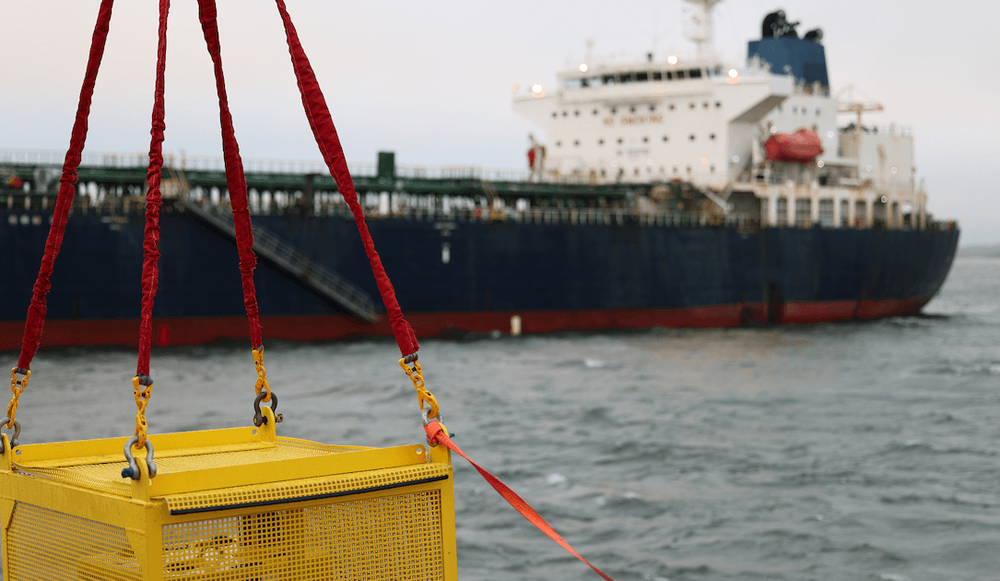
Finland appeals court revives case against Eagle S Officers over cable breaks
A Finnish appeals court on Thursday revived the collapsed prosecution of three senior officers of the Eagle S, the Russia-linked oil tanker that severed multiple subsea cables in the Baltic Sea on Christmas Day 2024.
The Helsinki Court of Appeal ruled that Finland has jurisdiction to try the men, overturning a district court judgment that had thrown out the case last October.
The appeals court sent the case back to the Helsinki District Court to be heard on its merits, although the three men, who had previously been detained in Finland, have since left the country.
The unanimous decision reverses a ruling that had alarmed the maritime legal community, where lawyers warned it could leave ships flying flags of convenience free to damage undersea infrastructure in international waters without consequence.
Henrik Ringbom, professor of maritime law at Åbo Akademi University, had said of the judgment: “As long as you have a flag state that doesn't care, you can now count on the freedom of navigation to continue to break cables without consequences. This means that no one can do anything about it. This is completely unreasonable.”
In its new ruling, the appeals court held that the alleged crimes were actually committed in Finland because the damage, and its effects on the country’s power and telecommunications supply, occurred there.
What is an accident?
Crucially, the court ruled that the events did not amount to a “maritime accident” under the United Nations Convention on the Law of the Sea. The defendants had relied on that provision to argue the case could be heard only by courts in the ship’s flag state — the Cook Islands — or in the crew members’ home countries of Georgia and India.
While the Finnish appeals court accepted Thursday that the Eagle S anchor’s initial drop could be regarded as accidental, and therefore would not have been prosecutable, it said what followed could not be considered an accident.
After Finnish authorities contacted the ship at 3:20 p.m. Dec. 25, the crew falsely told them both anchors were raised and secured, according to the court. The vessel then continued for about 90 kilometers (55 miles), dragging its port anchor for more than three hours and severing four additional cables.
Soon after the breaks, Finnish authorities dispatched armed units to board the ship by helicopter. The crew did not resist, and the Eagle S was seized by Finland’s National Bureau of Investigation on suspicion of aggravated criminal mischief.
The court found that the crew’s continued conduct after Finnish authorities made contact took the episode outside the “maritime accident” protection under the U.N. convention. It noted that only the intervention of Finnish authorities prevented additional cables from being severed.
Whether the Eagle S incident was accidental — either in legal terms or as a strategic concern — had been questioned intensely following a series of cable breaks in the Baltic Sea. The breaks had prompted fears Russia was attempting to destroy European infrastructure through deniable attacks below the threshold of war.
Many of those incidents have been linked to Russia’s so-called “shadow fleet,” a collection of up to 1,000 aging vessels with opaque ownership structures that sail under flags of convenience to export sanctioned Russian goods, particularly oil, helping fund Moscow’s war in Ukraine.
Officials from several European countries bordering the North and Baltic seas told Recorded Future News there is increasing confidence among their governments that the incidents were accidental and were not directed by the Kremlin.
The decision is not final and can be appealed to the Supreme Court if it grants leave. The deadline for an appeal is Oct. 26, 2026.
Implications
Deputy Prosecutor General Jukka Rappe told Finnish broadcaster Yle that the ruling aligned with the position of the prosecution and had come at a good time — weeks before a closely related trial is set to take place.
In June, prosecutors charged the captain and bosun of the Fitburg, a cargo ship that dragged its damaged anchor for at least 130 kilometers along the Baltic seabed on New Year’s Eve, again causing damage to civilian infrastructure. Those defendants have also denied wrongdoing and intend to argue that Finland lacks jurisdiction.
Rappe, who filed the Fitburg charges, has said his position on jurisdiction is the same in both cases and that the appeals court ruling would guide the Fitburg trial. A hearing date has not been set.
The Eagle S judgment also put a figure on the civil damages at stake. The joint owners of the Estlink 2 power cable — Fingrid, Finland’s state grid operator, and its Estonian counterpart, Elering — are seeking about €105 million ($122 million) from the three officers. That includes €55.3 million in repair costs and another €50 million in lost income.
When prosecutors first brought charges in August 2025, they estimated the immediate damage at “at least €60 million” in repair costs alone. Estlink 2 was out of service for about six months.
The court also rejected in full a claim by the Eagle S’ manager, Peninsular Maritime India, seeking more than €680,000 ($790,000) along with additional sums in U.S. dollars, UAE dirhams and Indian rupees, to cover its litigation costs.
Remaining disputes over costs were returned to the district court. The appeals court also rejected several secrecy requests, including an attempt to seal the officers’ employment contracts, although some technical material related to the cable will remain sealed until 2050.



Alexander Martin
is the UK Editor for Recorded Future News. He was previously a technology reporter for Sky News and a fellow at the European Cyber Conflict Research Initiative, now Virtual Routes. He can be reached securely using Signal on: AlexanderMartin.79