
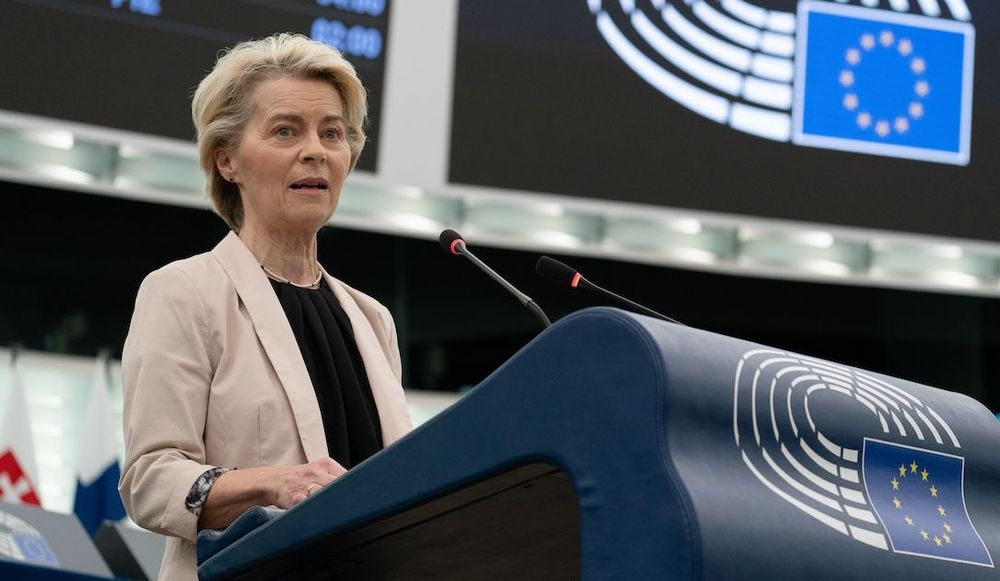
European Commission head pushes creation of new law delaying teens’ social media access
The president of the European Commission said Tuesday that she believes Europe must delay social media access for children, a significant new signal that the European Union could soon move forward with a plan that limits young teenagers’ use of the platforms.
An expert panel appointed by the commission will be releasing recommendations in the coming weeks for how the EU can do more to safeguard children online. Commission head Ursula von der Leyen said she expects their work could lead to a legal proposal delaying the age at which children can access social media as soon as this summer.
The European Commission only has the power to recommend legislation, so Europe’s parliament will have to pass a law for limits to be put into place. Still, experts said the comments are a sign of increased support for such restrictions.
“We are witnessing the lightning speed at which technology is advancing – and how it penetrates every corner of childhood and adolescence,” von der Leyen said at a conference in Copenhagen. “And the discussions about a minimum age for social media can no longer be ignored.”
The comments come as several European countries, including Spain, Greece, Norway, France, Denmark, Turkey and the Netherlands have said they are considering or are implementing age verification protocols to restrict young teens from accessing social media platforms.
The speech also focused on what von der Leyen sees as addictive design features embedded in the platforms.
The forthcoming Digital Fairness Act (DFA) will “target addictive and harmful design practices [like]... attention capture, complex contracts, subscription traps, etcetera,” von der Leyen said.
“In Europe, safety must be there from the start, not added as an afterthought.”
The DFA is expected to be unveiled later this year. It is designed to expand on the existing Digital Services Act (DSA), which targets social media companies for hosting harmful and unlawful content.
The commission is currently investigating Meta for possible DSA violations, including for not doing enough to protect minors and using addictive design features. It has also launched a DSA probe into xAI’s Grok nudification tool.
The president’s remarks about the bloc pursuing social media limits for young teenagers could be meant to highlight for member states that the European Commission is serious about taking action, experts said.
“The commission was seeing the debate percolate across a number of member states and so having a commission level action is one way to say, ‘Okay, member states, just hold your horses. Let's do something at EU level to not have fragmentation,’” said Isabelle Roccia, the managing director for Europe at the IAPP.
“That was significant… because she was the messenger and because it's a signal to member states that the EU level is seizing the issue.”



Suzanne Smalley
is a reporter covering digital privacy, surveillance technologies and cybersecurity policy for The Record. She was previously a cybersecurity reporter at CyberScoop. Earlier in her career Suzanne covered the Boston Police Department for the Boston Globe and two presidential campaign cycles for Newsweek. She lives in Washington with her husband and three children.